
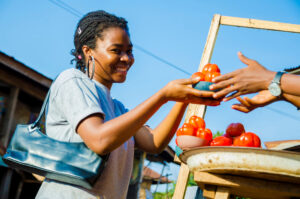
 Each morning in Sankuleh Kunda, a rural village in The Gambia’s Central River Region, 29-year-old Ramatulay arranges vegetables, spices, and packets of spaghetti outside her home. By evening, she switches to selling candles and small essentials. She doesn’t call herself a businesswoman. But her neighbors do.
A few years ago, Ramatulay, a mother of five, had no steady income. Her story began with a small loan of 3,000 dalasis (about 40 US dollars) from her village’s Community Management Committee, established through Tostan’s Community Empowerment Program. The committee, trained to support collective decision-making, offered low-interest loans to help community members start small businesses. Within four months, she had repaid half the loan, and her business was growing.
“This loan changed my life,” Ramatulay said. “Now I can pay school fees, buy food, soap, clothes, and medicine for my children. I feel happy knowing there is always food on the table. When my children are happy, I am more than happy.”
A Loan That Opened Doors
Across The Gambia, Community Management Committees are driving local progress from within. Composed of elected women, men, and youth, each committee is trained in the second year of Tostan’s program to manage development plans, promote accountability, and oversee microcredit systems.
After acquiring new skills in literacy, human rights, and project management, many women and youth access their first loans through Community Development Grants provided by Tostan and managed by the local Community Management Committee. In a context where formal bank loans are nearly impossible to obtain—especially for women and young people—these funds are changing what’s possible.
“Most program participants have started small businesses,” said Malick Jammeh, Chairman of the Village Advisory Committee. “From selling dried fish and ice cubes to running video clubs and selling gravel from the nearby hill, these women are excellent at repaying their loans, even with interest rates as low as five percent.”
Village Growth
The ripple effects of this progress are visible everywhere. The interest collected from individual loans contributes to a growing community fund, which now supports both small businesses and collective priorities. Over the past year, the local community fund—estimated at over 500,000 Dalasis (about 7,000 US dollars)—has helped Sankuleh Kunda drill two boreholes, cultivate rice fields, purchase a rice milling machine, and finance the training of a nurse for the village health post.
“We are also repairing the health post and fixing the ambulance,” said Tunko Sanyang, the village Community Management Committee Coordinator. “Pregnant women shouldn’t have to walk three and a half kilometers to give birth.”
Collective Progress
Sankuleh Kunda is now part of a growing network of communities advancing their own development. After completing Tostan’s education program, the village joined a post-program initiative focused on Reinforcement of Parental Practices and became an active member of the regional Community Management Committee Federation.
The combination of education, participation, and access to credit has reshaped what development looks like in rural Gambia.
What’s happening in Sankuleh Kunda is what happens when knowledge meets capital. A structured education program, led by local facilitators, equips people with tools for literacy, governance, and financial planning. When those tools are paired with community-managed microcredit systems, women and youth like Ramatulay gain the confidence and capacity to build a better future—one small business, one decision, one day at a time.